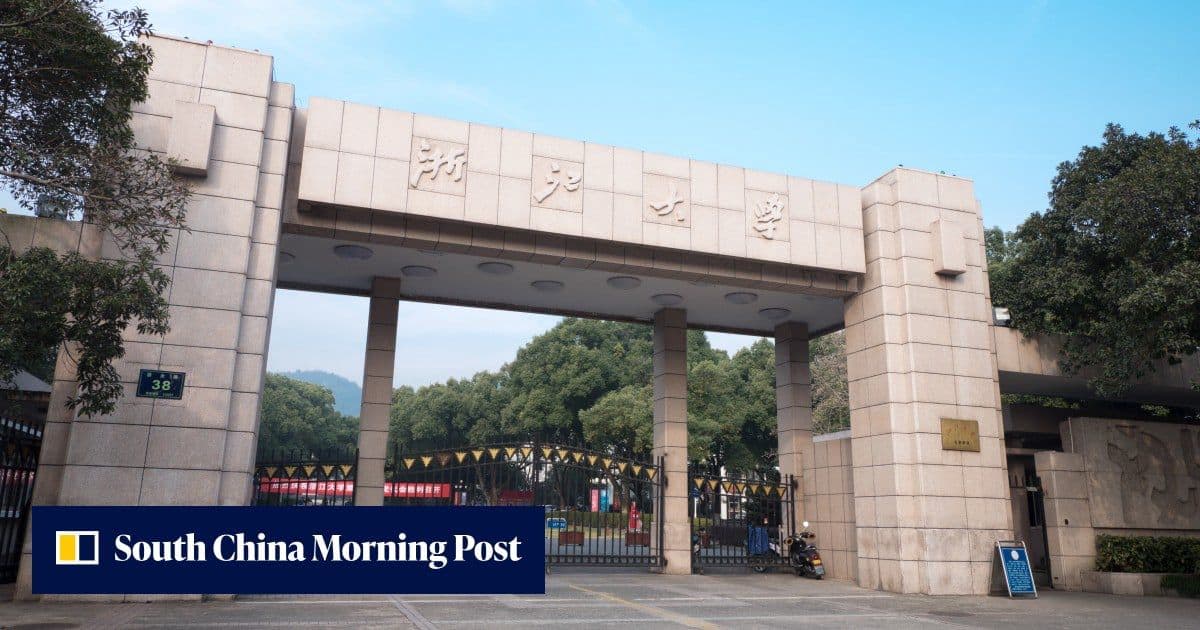
Even as China grows richer and more powerful, sadly, fewer American students appear to want to study there.
Fewer than 2,000 American students are now enrolled at Chinese universities, a dramatic drop from the peak of nearly 25,000 a decade ago. Ironically, this exodus comes even as China's economy and R&D expenditure have more than doubled or even tripled, with the country now dominating strategic sectors from electric vehicles to advanced manufacturing that were still in their infancy a decade ago. #Expats in China #China Education Policy Group #Edtech Innovation #ScholER #A Glance of China 行摄中国
Furthermore, American students face notoriously exorbitant university fees, often topping US$40,000 a year at private colleges - by comparison, an equivalent education in China costs a mere fraction of that. Yet, this profound affordability has failed to attract them.
“My biggest concern now is not that Chinese students are no longer going to the United States to study, but the opposite,” Lu Xiaobo, a professor of political science at Columbia University, said at a small gathering on Sino-US educational exchanges in Beijing in mid-August.
His anxieties are borne out by the data. According to a recent report by the non-profit organisation US-China Education Trust, the number of Americans studying in China has plummeted from about 11,000 in 2019 to fewer than 2,000 in 2026.
That is far below the peak of almost 15,000 US students enrolled at Chinese institutions for academic credit in the 2011-12 academic year, as reported by the New York-based Institute of International Education. According to data from China's Ministry of Education, there were more than 24,500 American students in China by 2012.
At the time, Washington had not formally designated China a strategic competitor or introduced a raft of policies aimed at pressuring, constraining and containing Beijing across a range of sectors.
China’s emerging industries, scientific research and ability to attract international talent had also yet to achieve their current global standing. Yet the appeal of Chinese universities has not kept pace with the country’s rise.
Scholars at the recent Beijing event identified several possible deterrents, including growing concern among American students about limits on access to academic research in China, and the potentially deleterious effect of studying in the country on future job prospects at home.
One university lecturer said during a Q&A session that, to his knowledge, some Chinese doctoral candidates at US universities had faced bureaucratic obstacles from local officials when returning home to conduct fieldwork.
Amy Gadsden, executive director of China initiatives at the University of Pennsylvania, echoed those concerns. Her programme coordinates and develops the university’s China-related strategy and activities.
She said American students were increasingly concerned about the professional ramifications of participating in exchange programmes in China.
“We get this question all the time: ‘If I want to work for the US government, will I be able to obtain security clearance if I’ve studied in China?’” Gadsden said in a recent interview with The Straits Times.
The retreat is not confined to overseas study. Even in the US, Lu said, China studies are attracting fewer American students.
“I have been teaching for 30 years,” Lu said. “The students now taking my courses and studying Chinese politics and economics increasingly have Chinese faces. Where have all the Americans gone? Why are they not interested?”
Data on Chinese-language enrolment tell a similarly bleak story. At Columbia, Lu said, enrolment in Mandarin courses peaked in the 2015–16 academic year and has steadily declined since. “The numbers are down across the US now,” he warned.
More troublingly, Lu said many of America’s younger China specialists today come from foreign policy backgrounds, with fewer focusing on China’s domestic politics, society and economy. He said this represented a shift from an earlier generation of scholars who examined the country’s internal social and economic challenges. “There used to be people writing books about China’s poverty,” Lu reflected.
The trend marks a poignant departure from the period after the normalisation of Sino-US diplomatic relations in the 1970s.
Back then, young Americans travelled across the Pacific in droves, eager to master Chinese and build ties with a rising global power. Between 1995 and 2012, the number of American citizens studying in China increased more than tenfold.
By late 2023, the number of Americans studying in China had plummeted to just 700. In early 2024, Nicholas Burns, the then US ambassador to China, told the Associated Press the number was far too low for a country of such strategic importance to the United States.
The decline in the number of Americans studying in China is more than an academic curiosity: it has geopolitical implications.
Analysts warn that shrinking student exchanges and waning interest in Chinese-language study are weakening Washington’s ability to understand and manage its most consequential bilateral relationship. Government agencies, think tanks and independent researchers are left to interpret Beijing’s decisions with a thinning pool of people equipped with deep, first-hand experience of China.
“If this trend continues … the US will face a critical shortage of grounded China expertise within a decade,” Rosie Levine, executive director of the US-China Education Trust, said in a recent interview.
A March report by the Washington-based non-profit organisation warned that the retirement of China specialists, coupled with the sharp decline in Americans studying in China, posed a “national security and an economic competitiveness” challenge.
For China, meanwhile, the exodus is a sobering reminder that its universities still have work to do to become genuinely global institutions, despite their rapid rise in the international rankings – according to some measures, surpassing America’s most prestigious universities (https://www.scmp.com/news..).
Although the number of Chinese students going to the US has also softened, nearly 266,000 were still enrolled on American campuses in the 2024-25 academic year.
“That is a highly unequal figure,” said Sun Chenghao, an international relations researcher at Tsinghua University.
Reversing the trend will require Beijing to take a more proactive approach, he said, including by investing in semester- and year-long immersive programmes, expanding scholarships and reducing the bureaucratic frictions of daily life.
"The ultimate goal should not be about convincing young Americans to 'like' China. It is about giving them the unvarnished opportunity to understand the reality and complexity of China on their own terms."